
Integrated Granulation Line
The Force Multiplier® - Integrated Pharmaceutical Wet Granulation Suite
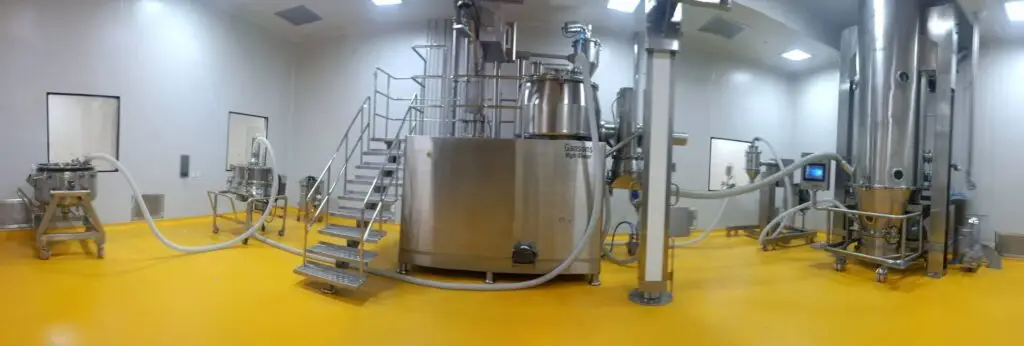
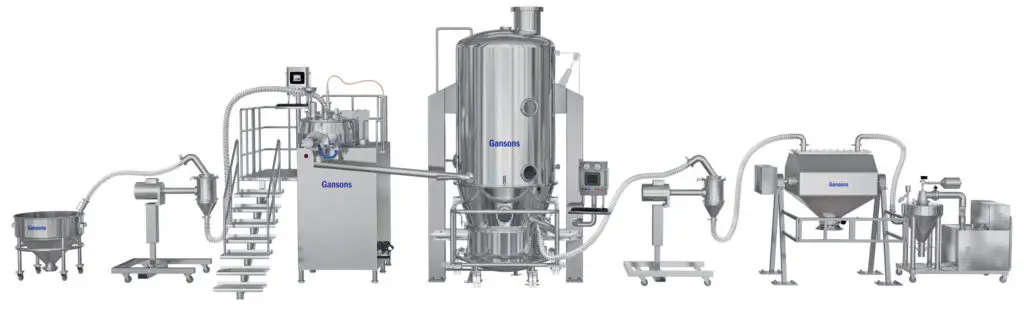
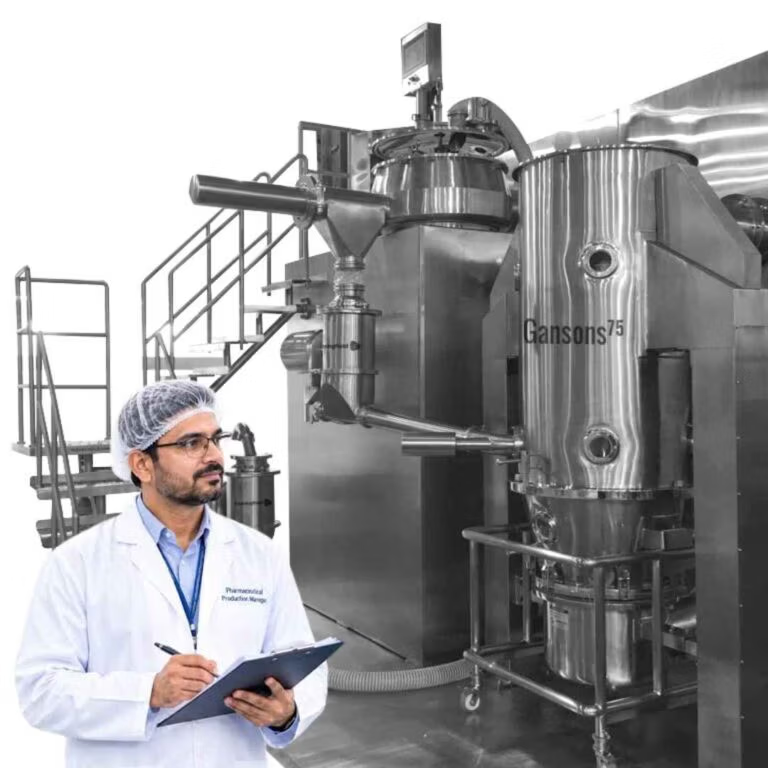
The Force Multiplier® is Gansons complete integrated wet granulation line, combining a High Shear Mixer Granulator, inline wet mill, Fluidised Bed Dryer, inline dry mill, and IBC Lift Blender under a single centralised automation platform. It eliminates manual inter-equipment transfers, reduces operator touchpoints, and delivers predictable, reproducible batch outcomes at up to 20 tonnes per day. The Force Multiplier® is the preferred wet granulation machine solution for the world’s fastest-growing regulated generic pharmaceutical manufacturers.
What is an integrated granulation line?
An integrated granulation line is a set of wet granulation equipment engineered to work as one system rather than as standalone machines. Each unit, from the granulator to the final blender, is sized for the same batch, connected by closed material transfer, and controlled from one recipe on one platform.
In a conventional plant, granules are discharged into containers, moved by hand or trolley, and recharged into the next machine at every stage. Each of those steps adds dust exposure, cleaning load, waiting time and a chance of deviation. A closed granulation line removes those breaks, so material flows from wet massing to compression-ready blend without open handling.
For pharmaceutical manufacturers, the result is a granulation process that is easier to validate, easier to scale and far more predictable from batch to batch. It is especially valuable for high-volume generics, potent APIs and plants moving towards automated, data-driven OSD production.
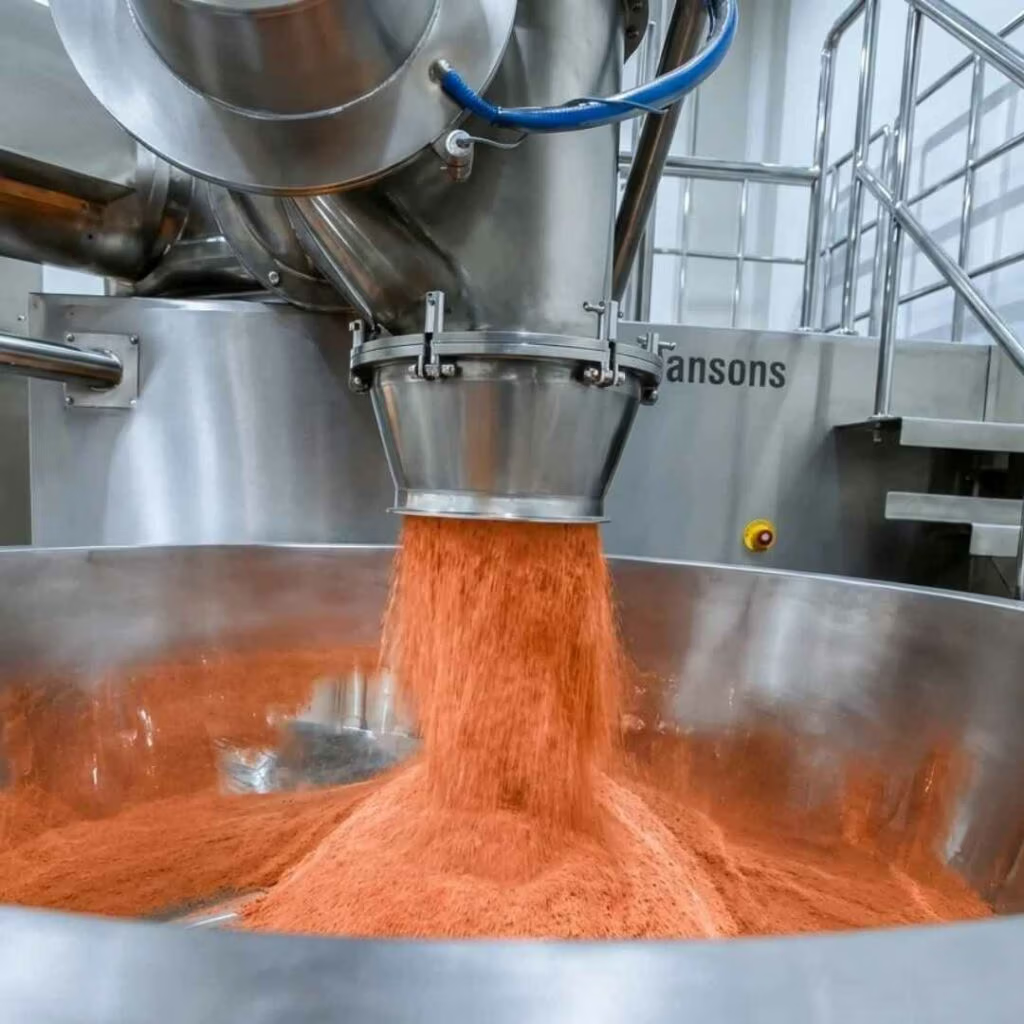
How the Force Multiplier® Granulation Line Works –
Step by Step
The granulation line runs the full wet granulation sequence in five closed stages. Each stage hands material directly to the next, so there is no open powder transfer between granulator and tablet press.
- Wet granulation in the HSMG. Dry powders and binder are mixed and massed in the High Shear Mixer Granulator. Electromechanical endpoint detection confirms granule formation consistently, batch after batch.
- Inline wet milling. On discharge, the wet mass passes straight through the inline wet mill, which breaks up lumps before they reach the dryer.
- Fluid bed drying with Cyklon®. Uniform wet granules are dried gently and evenly in the Fluidised Bed Dryer, with drying times up to 70% shorter than standard FBDs.
- Lifting and dry milling. A hydraulic lifting device raises the FBD product container and docks it to the inline dry mill, which sizes granules to the target particle size distribution.
- Final blending in the IBC. Lubricant is added and the final blend is completed inside the IBC, which then feeds the tablet press directly.
Inside the Granulation Line – Five Integrated Units
High Shear Mixer Granulator (HSMG)
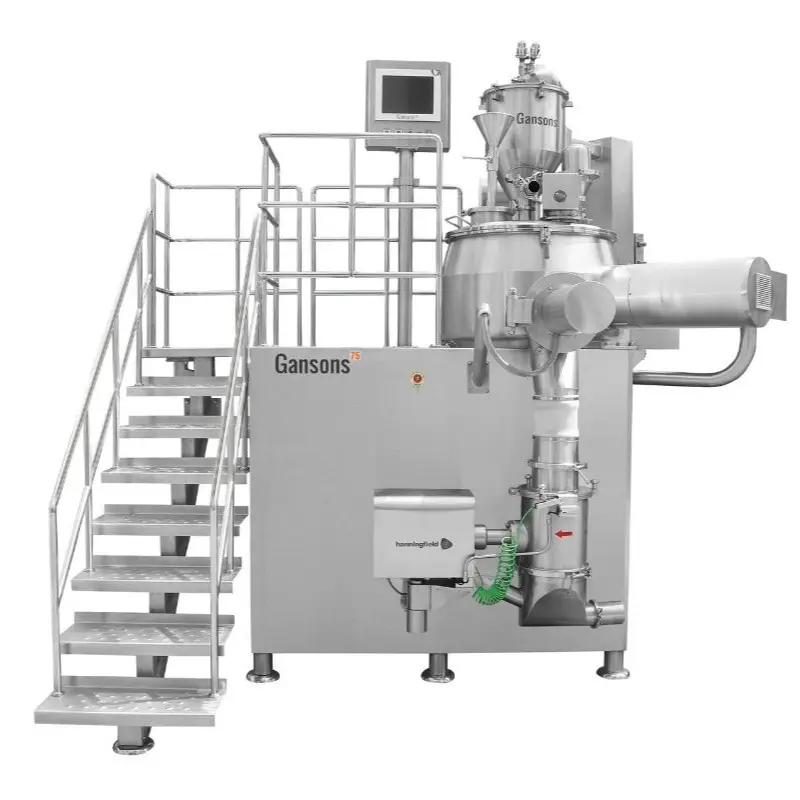
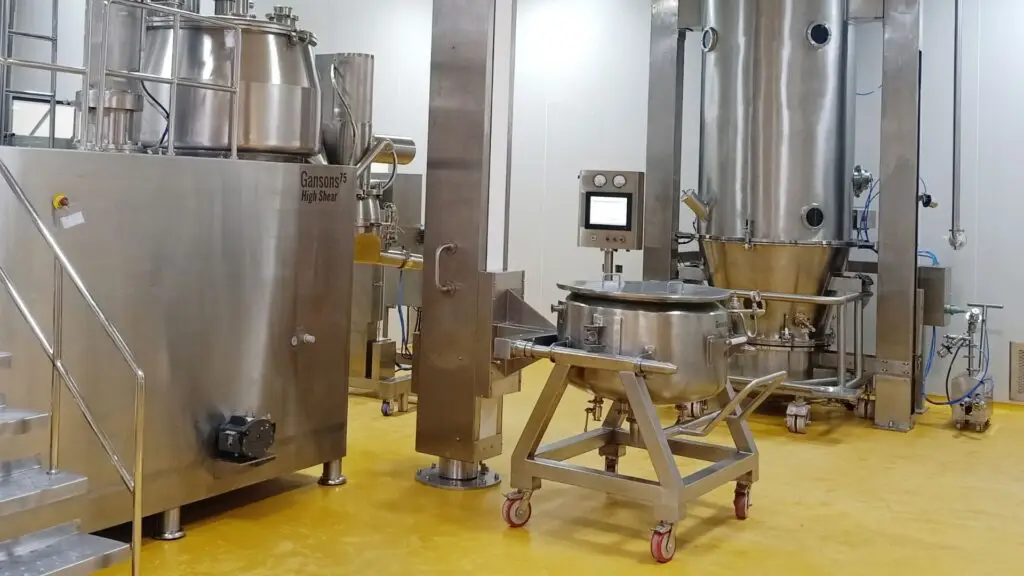
The core wet granulation equipment. Iwata™ impeller and chopper design, dead-spot-free bowl geometry, electromechanical endpoint detection, 12 Bar shock pressure resistance, ATEX rated configurations. See the HSMG product page for full technical detail.
Inline wet mill
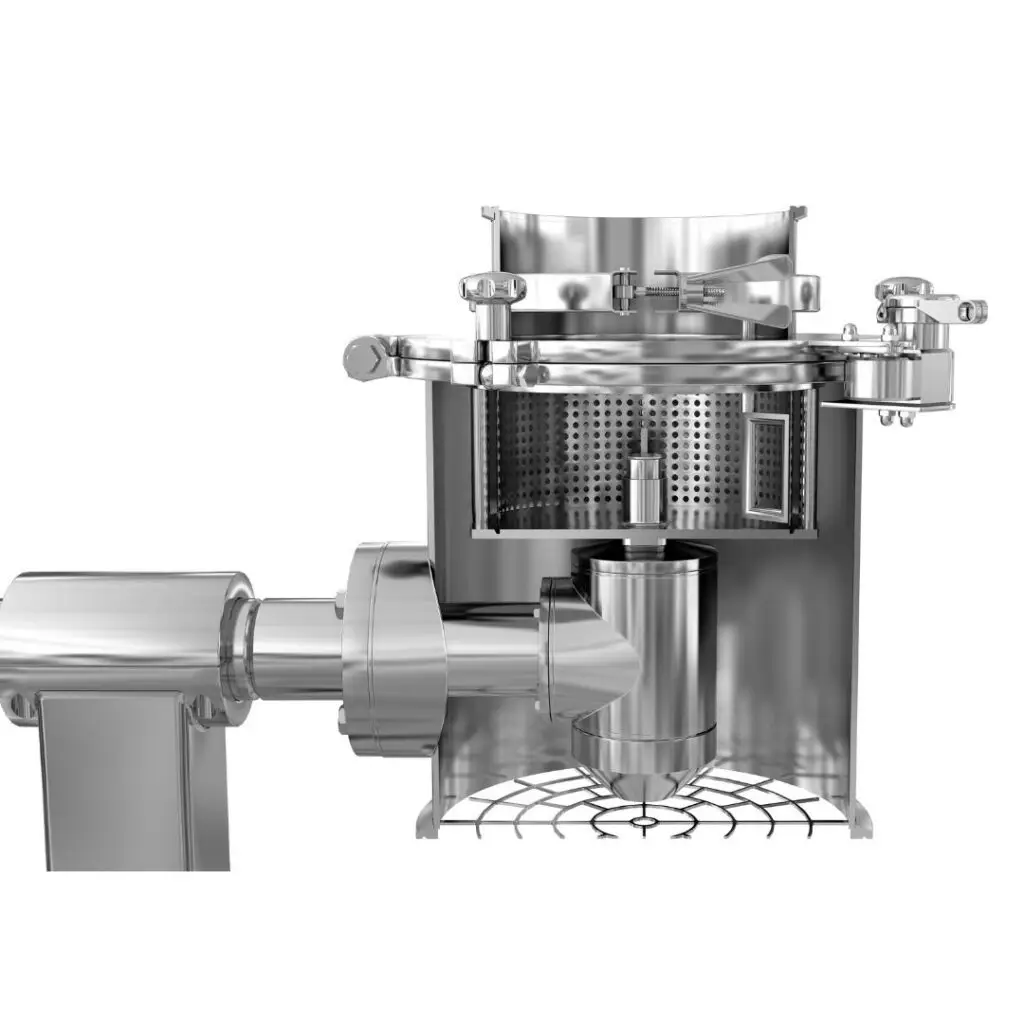
De-lumps wet granulate mass immediately on discharge from the HSMG before it enters the dryer. Lumps transferred directly to a FBD dry only on the surface, leaving wet centres that cause inconsistent moisture content and extended drying times.
Fluidised Bed Dryer with Cyklon®
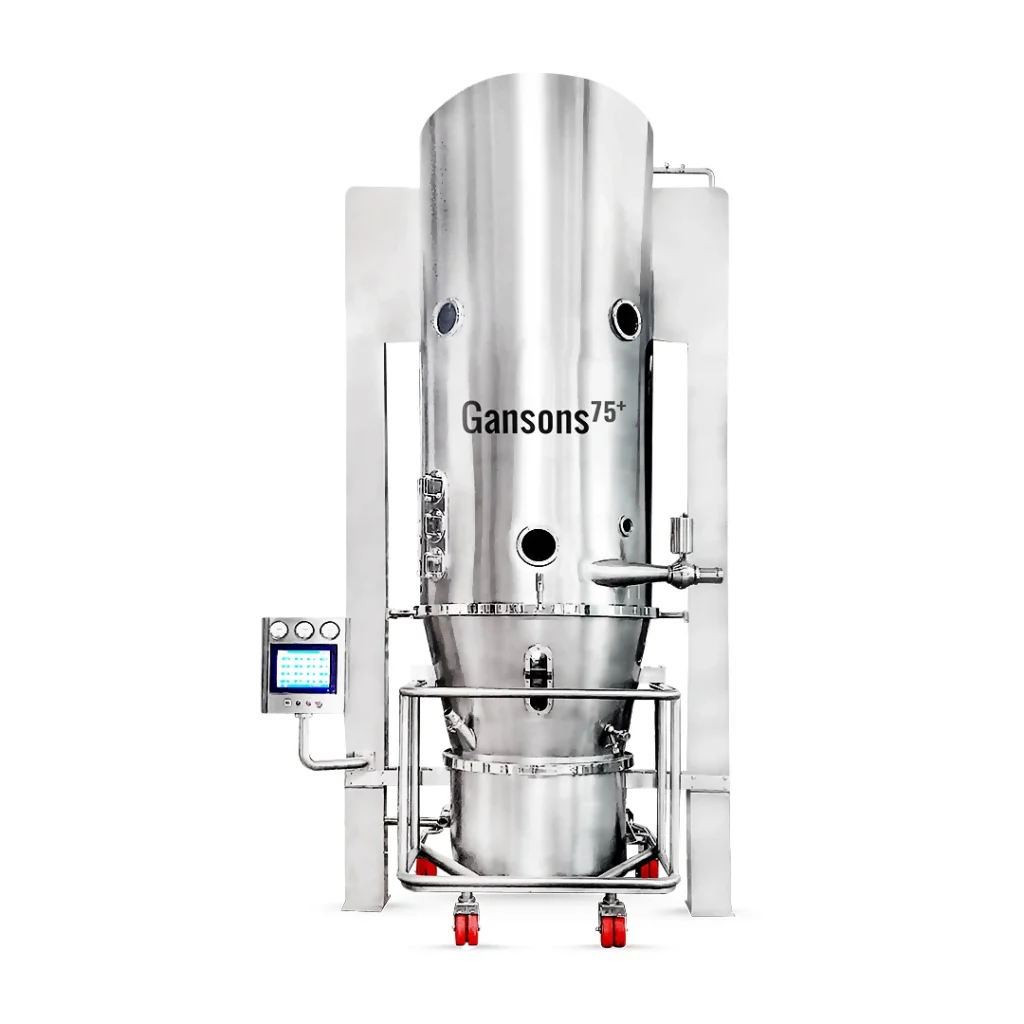
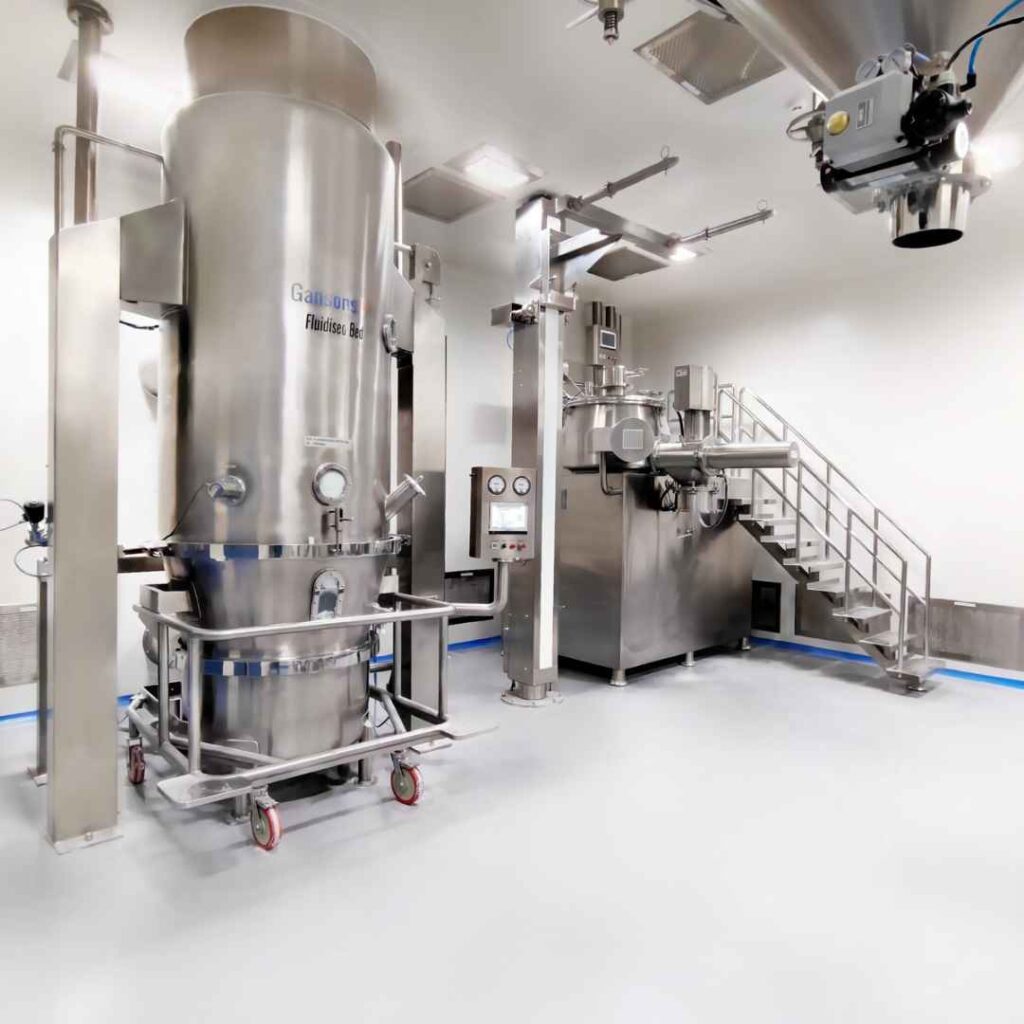
Gansons proprietary Cyklon® air distributor reduces drying time by up to 70% versus standard FBDs. Granules are dried uniformly and gently. See the FBD product page for full technical detail.
Lifting device with
Dry mill

A hydraulic lifting device raises the dried product container from the FBD and docks it to the inline dry mill for post-drying particle sizing, removing a manual transfer step. The dry mill delivers the target particle size distribution in a single automated step, ready for compression. Compatible with material handling system (MHS) and sifting operations.
IBC Bin Blender
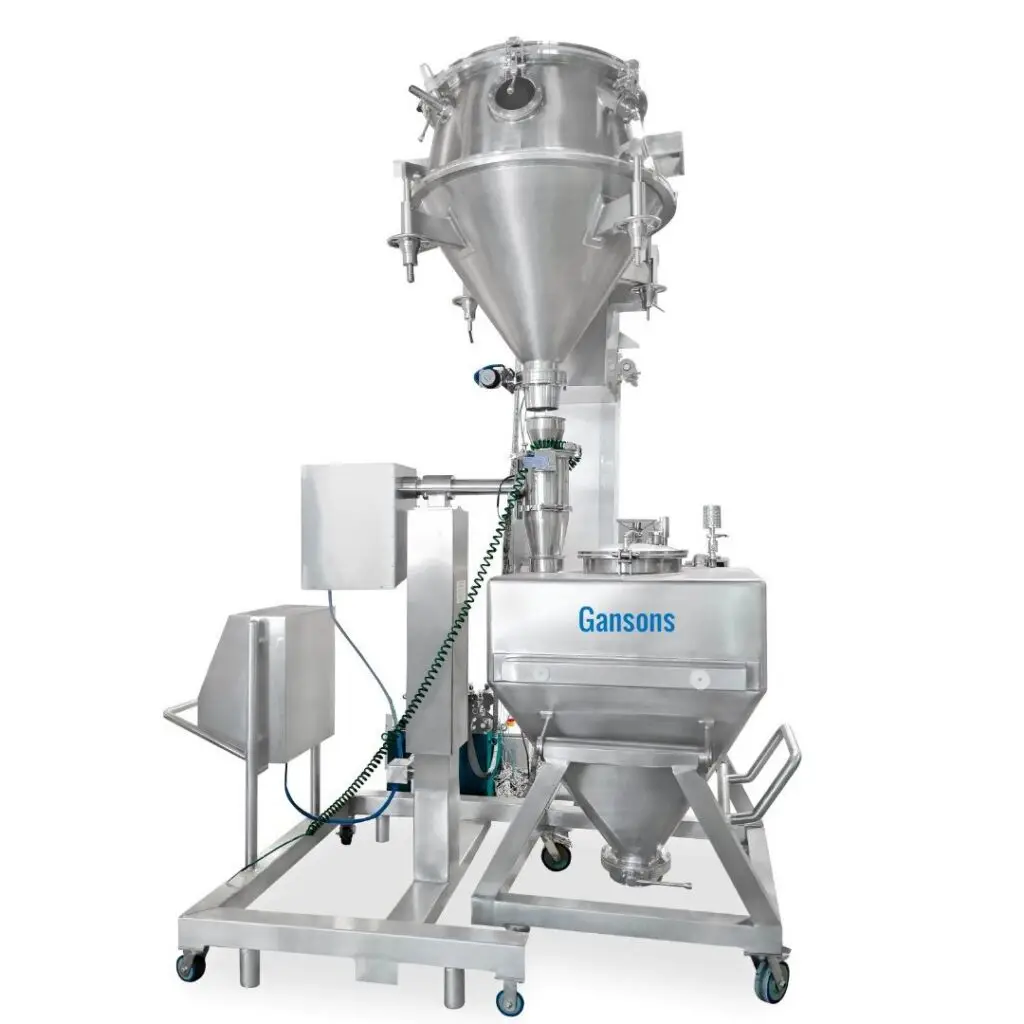
Lubricant addition and final blend are performed inside the IBC without material transfer. The blend is transferred directly to the tablet press, completing the granulation-to-compression sequence without a single open powder transfer.
Why Choose an Integrated Granulation Line?
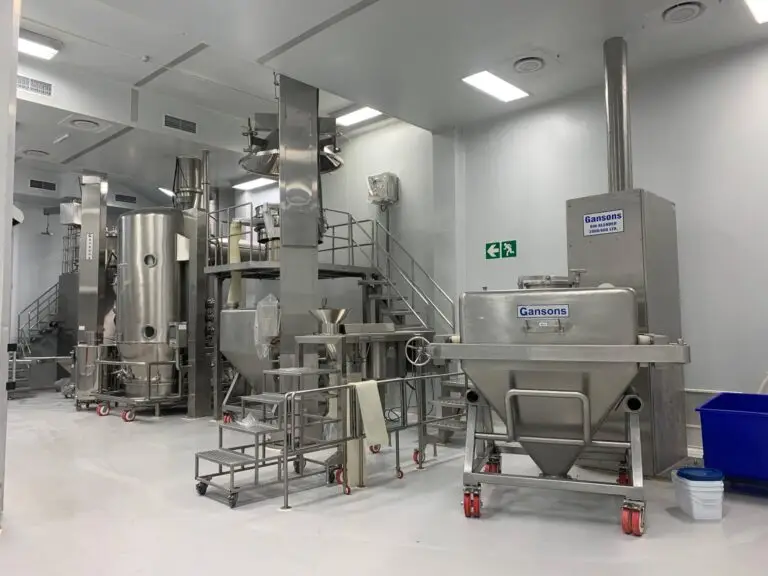
Higher efficiency
- Compact footprint: A space-efficient layout that does not sacrifice throughput.
- Line-balanced configuration: Every unit sized so no stage becomes a bottleneck.
- Wash-in-place (WIP): In-situ cleaning that can be recipe driven, cutting changeover time. See the Wash-In-Place System.
- Predictable scale-up: Consistent process behaviour from R&D batches to commercial production.
Increased Output with improved safety
- Closed material transfer minimises operator exposure from charging to final blend.
- Safety interlocks across every unit and transfer point.
- 12 bar shock-resistant designs available for structural integrity and containment.
- ATEX rated (flameproof) designs to suit your zoning; all components are compliant with a Zone 2/22 environment by default.
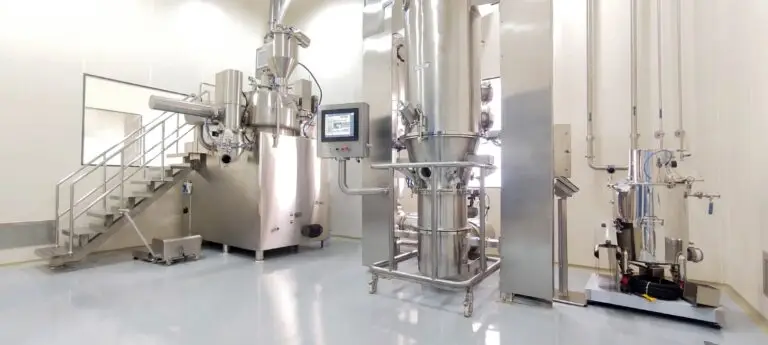
Increased Output with improved safety
- Closed material transfer minimises operator exposure from charging to final blend.
- Safety interlocks across every unit and transfer point.
- 12 bar shock-resistant designs available for structural integrity and containment.
- ATEX rated (flameproof) designs to suit your zoning; all components are compliant with a Zone 2/22 environment by default.
Integrated Granulation Line vs Standalone Granulation Equipment
Factor | Standalone machines | Gansons integrated granulation line |
|---|---|---|
Material transfer | Manual, open containers between each step | Closed, direct transfer from HSMG to IBC |
Operator exposure | High at every charge and discharge | Minimal; no open powder handling |
Lump handling before drying | Often none; wet centres extend drying | Inline wet mill de-lumps on discharge |
Drying time | Standard FBD cycle | Up to 70% shorter with Cyklon® |
Process control | Separate controls per machine | One recipe on one centralised platform |
Batch records | Compiled across systems | Unified reports and trend graphs per lot |
Cleaning | Machine by machine | Recipe-driven wash-in-place |
Scale-up | Re-validated per machine | Predictable, line-balanced scaling |
Labour | Several operators per transfer | Fewer touchpoints and operators |
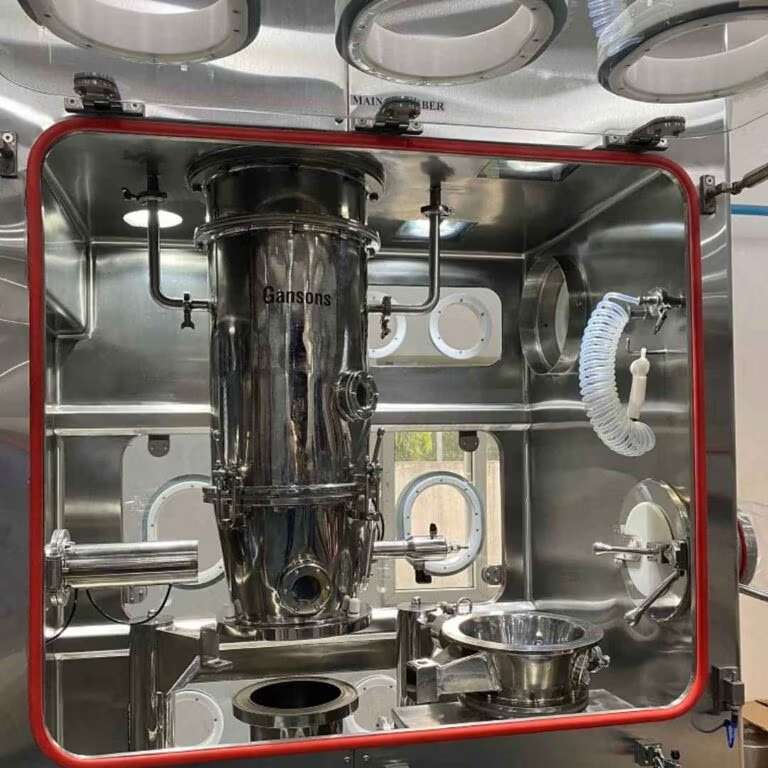
Containment and HPAPI Granulation
- Because every transfer in the granulation line is closed, potent and hazardous products never need open handling between granulator and press
- 12 bar shock-resistant construction and ATEX rated designs are available to suit the product and zoning.
- For HPAPI projects, Gansons' process technology team carries out OEB-specific containment assessments to define the right level of protection for each unit and transfer point.

Automation and Control
The whole granulation line runs on Gansons’ intelligent automation platform, so operators manage one recipe instead of five separate machines. Learn more about Gansons Automation Solutions.
- PLC/SCADA-based control with touch-screen HMI
- Centralised recipe management with role-based access control
- IoT enabled for remote monitoring and pre-emptive analytics
- Integrable with any site architecture including MES, ERP, and LIMS
- Customised reporting and smart graphs for lot reproducibility
- Industry-leading IPC processors for fast, reliable control performance
- 21 CFR Part 11 compliant automation available as an add-on for regulated pharmaceutical facilities
- GAMP 5-aligned computerised system validation documentation supplied with 21 CFR Part 11 configurations
Applications of the Wet Granulation Line
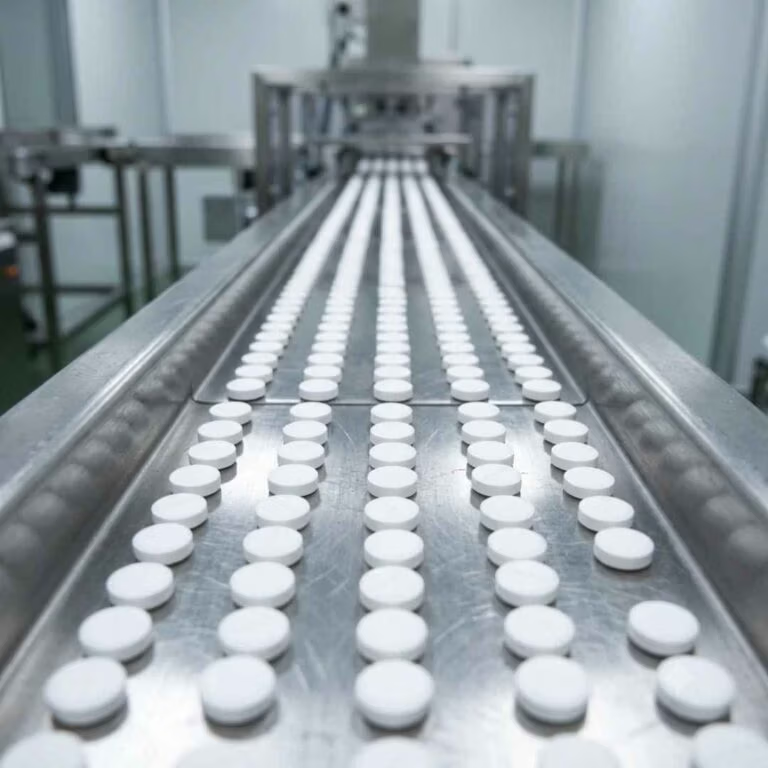
- Generic tablet manufacturing: High-volume, multi-product OSD plants that need steady daily tonnage.
- Regulated export facilities: Plants supplying US, UK, EU and other regulated markets that need consistent batch records.
- Potent and HPAPI products: Closed transfer and OEB-specific containment for operator safety.
- Solvent-based granulation: ATEX rated, flameproof configurations for hazardous zones.
- Nutraceuticals, food and chemicals: Wet granulation of powders that need uniform, free-flowing granules.
How to Choose the Right Granulation Line
Use these questions to scope a wet granulation line before you request a quote:
- What daily output do you need? Start from tonnes per day and shifts, then work back to batch size and batches per shift.
- What is your product mix? Many products with frequent changeovers favour recipe-driven wash-in-place and centralised recipe control.
- How potent are your APIs? OEB level defines the containment design for every transfer point.
- Will you use solvents? Solvent granulation needs ATEX rated, flameproof equipment matched to your zoning.
- What space do you have? Floor area and ceiling height decide between a single-level and a multi-level layout.
- What data integrity rules apply? Plants supplying regulated markets usually need 21 CFR Part 11 and GAMP 5 documentation.
- How will you scale? Pilot and R&D equipment such as inONE® shortens technology transfer to the commercial line.
Compliance and Certifications
Installed in facilities regulated by US-FDA, UK-MHRA, EMA, WHO-GMP, Japan-PMDA, TGA, SAHPRA, MCC, and health authorities in 40+ countries. CE, UL, ATEX, ISO, and IEC configurations available on request.





Frequently asked questions
What is a granulation line in pharmaceutical manufacturing?
A granulation line is a connected set of equipment that turns fine powders into uniform granules ready for tablet compression. A wet granulation line typically includes a high shear mixer granulator, a wet mill, a fluid bed dryer, a dry mill and a blender.
What does the Force Multiplier® include?
What is the difference between an integrated granulation line and standalone granulation equipment?
Standalone machines need manual, open transfers between each step. An integrated granulation line links every unit with closed transfer and one control system, which cuts exposure, labour and batch-to-batch variation.
Why is an inline wet mill important in a granulation suite?
Lumps from the HSMG dry only on the surface in the FBD, leaving wet centres. The inline wet mill de-lumps the granulate mass immediately on HSMG discharge, ensuring uniform particle size, consistent drying, and better granule structure for compression.
What throughput can the Force Multiplier® achieve?
Up to 20 tonnes per day in high-capacity configurations. Individual line sizing is customised to customer throughput requirements, regulatory environment, and facility footprint.
Is the Force Multiplier® suitable for HPAPI manufacturing?
Yes. Closed material transfer throughout the line eliminates open powder handling. ATEX rated and 12 Bar configurations are available as per customers request. Gansons process technology team provides OEB-specific containment assessments for HPAPI granulation projects.
Can the granulation line handle solvent-based granulation?
Yes. ATEX rated, flameproof designs are available based on your zoning requirements. All components are compliant with a Zone 2/22 environment by default.
Is the granulation line 21 CFR Part 11 compliant?
21 CFR Part 11 compliant automation is available as an add-on, supplied with GAMP 5-aligned computerised system validation documentation.
Can the granulation line integrate with our MES, ERP or LIMS?
Yes. The automation platform integrates with any site architecture, including MES, ERP and LIMS, and supports IoT-based remote monitoring.
How is the granulation line cleaned between batches?
An integrated wash-in-place (WIP) system cleans equipment in situ and can be recipe driven, reducing changeover time and manual cleaning.
Can the line scale from R&D to commercial production?
Yes. The line is designed for predictable scale-up, and Gansons’ inONE® R&D equipment supports development work before transfer to the commercial granulation line.
Downloads
Gallery