

Pharmaceutical Sifter Machines Vibratory Sifters and Centrifugal Sifters
Gansons manufactures pharmaceutical sifter machines for every powder screening application – from routine security sifting of incoming raw materials through to precision particle size classification and multi-fraction grading. Two sifter technologies are available: the Gansons Vibratory Sifter machine (gyratory/vibro sifter) and the centrifugal sifter – each suited to different applications, throughput requirements, and powder characteristics.
Gansons has been manufacturing vibratory sifters for over 50 years. Today, our sifters are in active use at virtually every major multinational pharmaceutical company, and at top Indian pharmaceutical manufacturers across the generic and innovative sectors. A machine that has earned that level of trust does not do so by accident – it does so through engineering quality, reliability, and the kind of after-sales support that only comes from decades of application knowledge.
How Sifting Works - Two Technologies, Two Mechanisms
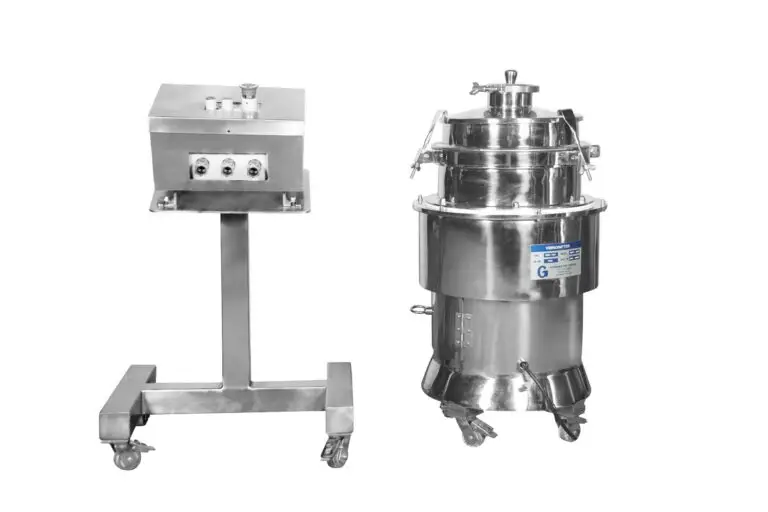
Vibratory Sifting - Gyratory / Circular Motion
The Gansons Vibratory Sifter Machine operates on the gyratory sifting principle. An out-of-balance motor below the sifter machine generates a three-dimensional circular vibration that is transmitted to the sifter body and the mesh screen. As powder is fed onto the screen, the gyratory motion causes particles to spiral outward from the centre towards the periphery of the screen. Particles smaller than the screen aperture pass through and exit as the accepted fraction. Particles larger than the screen aperture – lumps, agglomerates, oversized granules, and foreign material – are conveyed to the periphery and exit through a separate oversize outlet.
The circular motion covers the entire screen surface efficiently, ensuring that no part of the screen is statically loaded. The amplitude of vibration is adjustable, allowing the sifter to be optimised for powders of different bulk density, flow properties, and moisture content. This makes the gyratory sifter a highly versatile machine – effective across the full range of pharmaceutical, food, chemical, and personal care powder applications.
Centrifugal Sifting - Mechanical / Rotary Action
The centrifugal sifter (also called a mechanical sifter or inline sifter) operates on a different principle. Powder is fed into a horizontal cylindrical chamber where a rotating paddle or brush rotor continuously forces the powder through a cylindrical mesh screen by centrifugal force. The high-frequency mechanical contact between the rotor and the powder provides both de-agglomeration and security screening in a single pass.
The centrifugal mechanism is particularly effective for security sifting of light, fluffy powders that would blind or bridge on a conventional vibratory screen — because the rotor continuously re-exposes fresh screen surface and actively pushes the product through. It is widely used as an in-line security sifter between process steps, particularly on transfer from container to blender or from blender to tablet press.
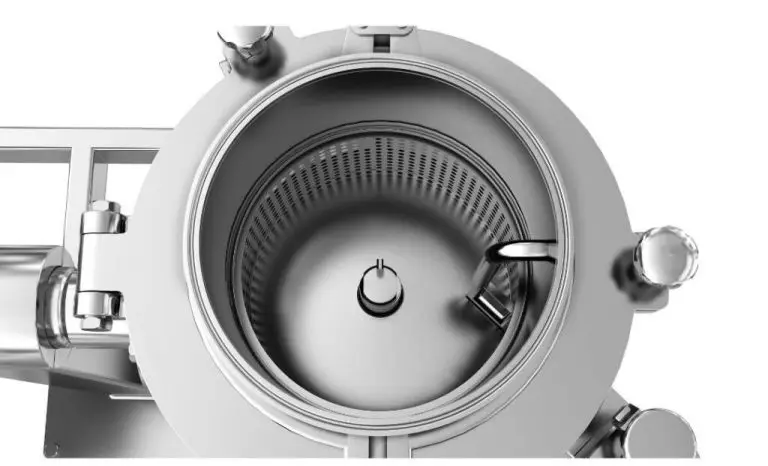
Centrifugal Sifting - Mechanical / Rotary Action
The centrifugal sifter (also called a mechanical sifter or inline sifter) operates on a different principle. Powder is fed into a horizontal cylindrical chamber where a rotating paddle or brush rotor continuously forces the powder through a cylindrical mesh screen by centrifugal force. The high-frequency mechanical contact between the rotor and the powder provides both de-agglomeration and security screening in a single pass.
The centrifugal mechanism is particularly effective for security sifting of light, fluffy powders that would blind or bridge on a conventional vibratory screen — because the rotor continuously re-exposes fresh screen surface and actively pushes the product through. It is widely used as an in-line security sifter between process steps, particularly on transfer from container to blender or from blender to tablet press.
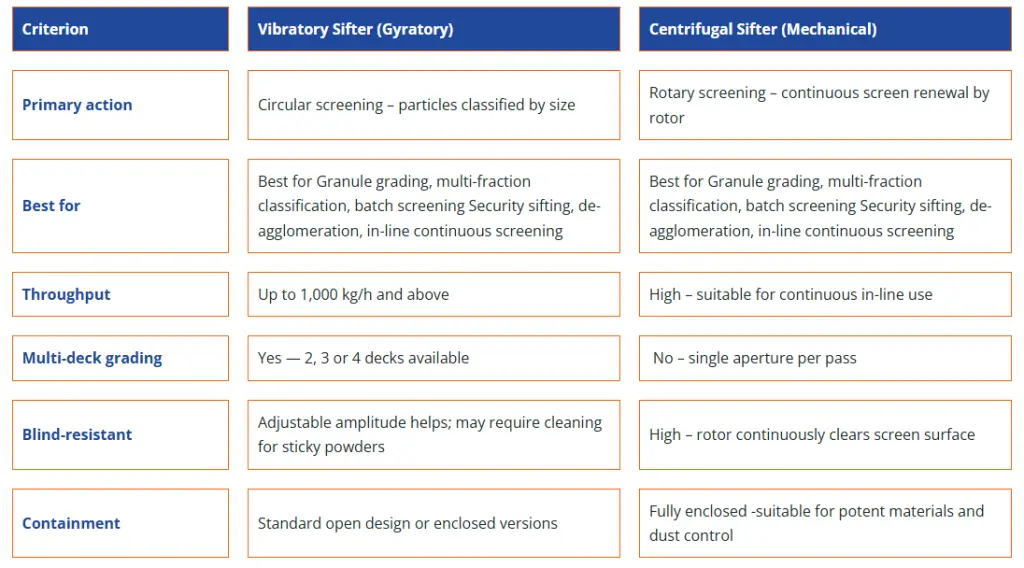
Which sifter is right for my application?
Criterion
Vibratory Sifter (Gyratory)
Centrifugal Sifter (Mechanical)
Primary action
Circular screening – particles classified by size
Rotary screening – continuous screen renewal by rotor
Best for
Best for Granule grading, multi-fraction classification, batch screening Security sifting, de-agglomeration, in-line continuous screening
Best for Granule grading, multi-fraction classification, batch screening Security sifting, de-agglomeration, in-line continuous screening
Throughput
Up to 1,000 kg/h and above
High – suitable for continuous in-line use
Multi-deck grading
Yes — 2, 3 or 4 decks available
No – single aperture per pass
Blind-resistant
Adjustable amplitude helps; may require cleaning for sticky powders
High – rotor continuously clears screen surface
Containment
Standard open design or enclosed versions
Fully enclosed -suitable for potent materials and dust control

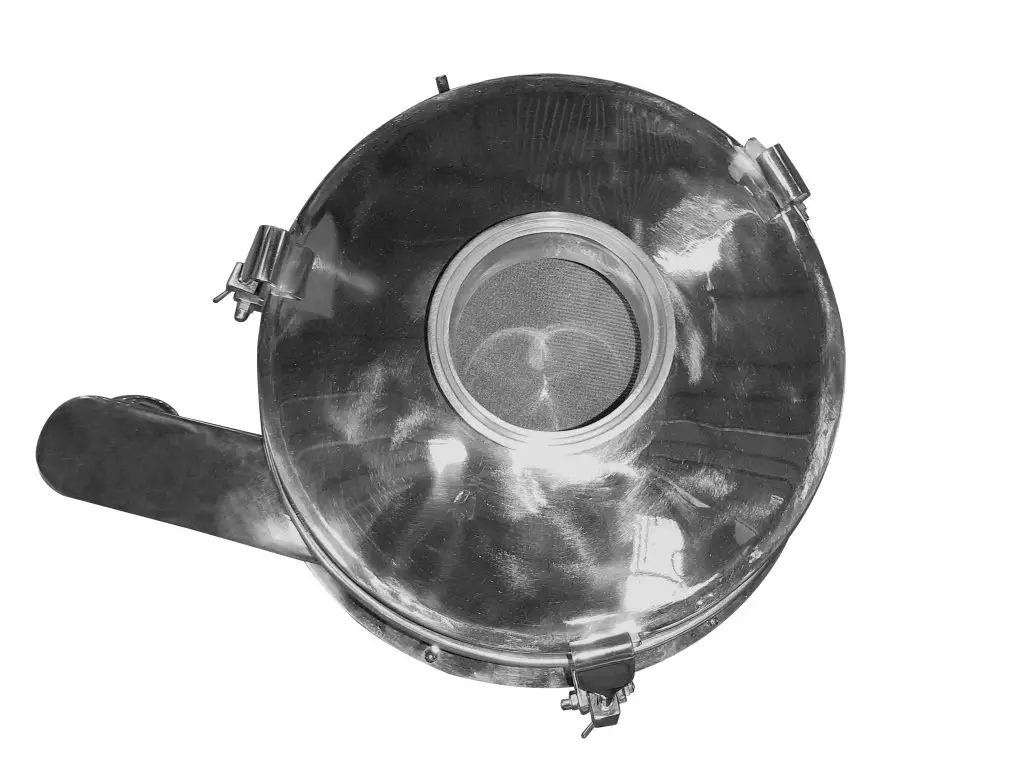
Gansons Vibratory Sifter
The Gansons Vibratory Sifter Machine (vibro sifter) is a gyratory sifting machine manufactured to cGMP standards for pharmaceutical, nutraceutical, food, chemical, and personal care powder processing. Available as a single-station sifter for security screening, and as a multi-deck sifter for particle size grading and classification, the Gansons sifter delivers consistent particle size control with minimal operator intervention.
Single-Station Vibratory Sifter
The single-station configuration uses one mesh screen to separate powder into two fractions: the accept fraction (passing through) and the oversize fraction (retained on screen and discharged separately). Single-station sifters are used for:
- Security sifting of raw materials and API – detecting and removing foreign objects (nuts, bolts, packaging fragments, insect contamination) from incoming raw materials before use in manufacturing
- De-lumping after weighing and dispensing – breaking down agglomerates that form during storage or handling before the material enters the blending or granulation process
- Post-milling classification – removing fines or oversize particles after milling to ensure a tight particle size distribution before compression
- Quality assurance screening – confirming particle size compliance of blend or granule before the next process step
Multi-Deck Vibratory Sifter - Particle Size Grading and Classification
The multi-deck (multi-station) configuration uses two, three, or four mesh screens stacked vertically within the same sifter body, each with a progressively smaller aperture from top to bottom. Powder fed onto the top deck cascades through each successive screen, with each fraction exiting from a separate outlet spout. This enables simultaneous classification of the powder into multiple particle size fractions in a single machine.
Multi-deck sifting is used for:
- Particle size grading of granules – separating granule output from fluid bed dryers or high shear granulators into defined size fractions for compression suitability assessment or for pharmaceutical development
- Calibration screening using a sieve stack – using a defined set of screen apertures (e.g., 1400μm / 850μm / 250μm) to generate a particle size distribution profile across a batch of granules or powder
- Rejection of fines and coarse fractions – simultaneously removing both undersized fines and oversized granules from a batch, retaining only the target size fraction for compression
- Multi-product classification – using different deck configurations to service different product particle size requirements on the same machine
Mechanical Features & Engineering Quality
Adjustable Gyratory Amplitude
The amplitude of the gyratory vibration is continuously adjustable via the out-of-balance weight settings on the vibrating motor. This is a critical operational parameter — finer powders and cohesive materials typically require higher amplitude to prevent screen blinding, while coarser granules and free-flowing materials perform well at lower amplitude settings. Adjustable amplitude means the sifter can be optimised for each product without hardware changes.
Quick Disassembly and Screen Interchangeability
All Gansons sifter screen frames and body sections are secured with quick-release clamps, allowing complete disassembly for screen change, product changeover, and cleaning validation without tools. All product-contact parts are accessible and removable — there are no hidden internal surfaces that could trap product or prevent adequate cleaning. This design is essential in pharmaceutical environments where validated cleaning between products is mandatory.
Screens are interchangeable across compatible sifter models – the same screen frames and mesh inserts can be used across multiple Gansons sifters of the same diameter specification, minimising the spare screen inventory required. Gansons stocks a comprehensive range of standard mesh screens and replacement parts for immediate despatch.
Stainless Steel Construction and Surface Finish
All product-contact surfaces are manufactured from 316L stainless steel with a polished finish (Ra ≤ 0.8 µm as standard). Screens are manufactured from precision-woven 316L stainless steel wire mesh. Non-contact structural components are 304 stainless steel. The construction meets FDA and cGMP requirements for product contact surfaces in pharmaceutical manufacturing. Welds are fully continuous and internally polished — no crevices, no product traps.
Energy Efficiency
The gyratory vibration mechanism used in Gansons sifters requires significantly less energy than reciprocating vibratory systems (which move the entire machine mass back-and-forth) because only the out-of-balance mass provides the excitation force. This translates to lower motor ratings, lower energy consumption, and reduced mechanical stress on the structure and screen frame.
Spares and Screen Availability
Gansons holds a comprehensive stock of replacement mesh screens, seal rings, clamps, and wear parts for all current and legacy Gansons sifter models. Because Gansons has been manufacturing sifters for over 50 years, spare parts are available for machines that may be decades old. All screen specifications are maintained in Gansons’ engineering records, and replacement screens can be manufactured to the original specification even for discontinued models. This longevity of spares support is a significant operational advantage in regulated pharmaceutical facilities, where equipment qualification must be maintained throughout the working life of the machine.
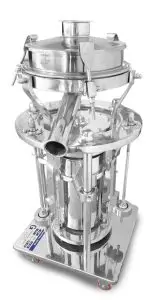
Capacity Range
Throughputs of 1,000 kg/hr or higher
Frequently asked questions
What is a vibratory sifter and how does it work?
A vibratory sifter – also called a vibro sifter or gyratory sifter uses a three-dimensional circular (gyratory) motion generated by an out-of-balance motor to move powder across a mesh screen. Particles smaller than the screen aperture pass through as the accepted fraction; oversized particles, lumps, and foreign material are conveyed to the periphery of the screen and exit separately. The adjustable amplitude allows the machine to be optimised for different powder types. Gansons (pharmaceutical equipment manufacturers) has been manufacturing vibratory sifters for over 50 years.
What is the difference between a vibratory sifter and a centrifugal sifter?
A vibratory (gyratory) sifter uses circular motion to pass powder through a flat horizontal screen. It is suited to batch screening, multi-fraction grading with multiple deck screens, and a wide range of powder types. A centrifugal sifter uses a rotating rotor inside a cylindrical screen to force powder through the mesh by centrifugal action – providing high throughput, continuous in-line screening, and effective de-agglomeration. Centrifugal sifters are preferred for in-line security sifting of light or fluffy powders that might blind a flat screen.
What is security sifting and why is it required in pharmaceutical manufacturing?
Security sifting is the screening of raw materials (APIs, excipients) before use in manufacturing to detect and remove foreign objects – including packaging fragments, metal particles, and other contaminants introduced during storage or transport. It is required as a standard cGMP practice and is referenced in FDA 21 CFR Part 211 and EU GMP guidelines as part of the raw material verification process. A single-station vibratory sifter with a coarse to medium aperture screen is typically used for security sifting.
What is a multi-deck sifter and what is it used for?
A multi-deck sifter uses two, three, or four mesh screens stacked vertically within the same sifter body, each with a progressively smaller aperture. Powder fed onto the top screen is classified into multiple particle size fractions, each exiting from a separate outlet. Multi-deck sifters are used for pharmaceutical granule grading (separating granule output into defined size fractions), particle size distribution profiling using a calibrated sieve stack, and the simultaneous removal of both fines and coarse oversize from a batch.
How long does a Gansons sifter last, and are spare parts available for older machines?
Gansons has been manufacturing vibratory sifters for over 50 years, and many machines from the 1990s and early 2000s remain in active production use today. Spare parts — including replacement mesh screens, seal rings, clamps, and motor components — are held in stock for current models and can be manufactured to original specification for legacy machines. Gansons maintains complete engineering records for all machines ever produced. This long-term spares support is particularly valuable for regulated pharmaceutical facilities where equipment qualification must be maintained throughout the machine’s working life.
What is the capacity of a Gansons vibratory sifter?
The Gansons vibratory sifter machine achieves throughputs of 1,000 kg/h and above depending on screen aperture, powder bulk density, particle size distribution, and moisture content. Contact the Gansons technical team with your material properties and required throughput for a specific capacity recommendation and model selection.
Compliance and Certifications






50+ Years of Vibratory Sifter Manufacturing.
A Track Record That Speaks for Itself
Gansons has been manufacturing vibratory sifters for over five decades. That longevity is not a coincidence — it reflects a machine that works consistently, requires minimal maintenance, and earns the trust of quality teams in regulated pharmaceutical facilities worldwide.
Today, Gansons sifters are in active use at virtually every major multinational pharmaceutical company operating in India – including global top-10 manufacturers across generic and branded pharmaceutical manufacturing. Leading Indian pharmaceutical companies, across both bulk drug and formulations sectors, have relied on Gansons sifters for decades of uninterrupted production. Many facilities operate Gansons sifters that have been in continuous service for 15, 20, or even 30 years – a testament to the durability of the engineering.
This installed base gives Gansons something that newer entrants to the market cannot offer: a depth of application knowledge across thousands of different pharmaceutical, food, chemical, and personal care formulations, accumulated through five decades of process support. When a customer asks how to optimise sifting for a particular granule or powder, Gansons engineers have almost certainly encountered that product type before.